

Maternity Hospital in Bangalore: How to Choose, and What to Ask Before You Book
A good maternity hospital in Bangalore is one where you trust the doctor, emergency and newborn care are ready at any hour, and you know the plan and the costs before labour starts. This page is written for women and families who are comparing hospitals. It explains what to check, how to verify what a hospital tells you, and how antenatal care works at Sai Speciality Center in Kasturi Nagar, where Dr. Kavitha Lakshmi Easwaran (MBBS, MD (OBG)) follows your pregnancy from the first visit.
One thing first, so that nothing surprises you later: we are a specialist clinic, not a hospital. Your check-ups, scans and planning happen with us, and your delivery is planned with Dr. Kavitha at a partner hospital.
Quick answers
- Are you a maternity hospital? No. We are a clinic. Antenatal care is at the clinic, and delivery is planned with Dr. Kavitha at a partner hospital.
- When should I book my first visit? As soon as a home test is positive, ideally before 12 weeks.
- What care do you offer? Preconception advice, antenatal check-ups, scans and tests, high-risk pregnancy care, delivery guidance and postnatal follow-up.
- Can I move my care to you part-way through pregnancy? Yes. Bring all your reports.
- Can I come only for a second opinion? Yes.
- How do I book? Call 80887 01001 or 99019 25700.
Is There a “Best” Maternity Hospital in Bangalore?
Many families search for the “best” or “top” maternity hospital in Bangalore, and the results are long lists of hospitals with star ratings. These lists can be a starting point, but they have limits. Most are built from brand size, number of beds, advertising and online reviews. Almost none of them measure the things that decide how a birth goes: how quickly an emergency caesarean can start, how the team supports a woman in labour, what happens to a baby who needs special care, and how openly the hospital talks about costs.
There is also no single answer that suits everyone. A woman expecting her first baby with no health problems needs something different from a woman with diabetes, a woman expecting twins, or a woman who has had a caesarean before. A hospital that is right for one family can be the wrong choice for another. Distance matters too. In a city with traffic like Bangalore’s, a hospital that takes ninety minutes to reach at night is a real risk, whatever its reputation.
So instead of asking which hospital ranks first, ask which hospital is right for your pregnancy, your doctor and your home. The checks below help you answer that.
Ten Checks Before You Choose a Maternity Hospital
- Who will deliver your baby? Ask whether it will be the doctor who has followed your pregnancy or whoever is on duty. Both arrangements exist. Neither is wrong, but you should know which one you are getting.
- Can an emergency caesarean start at any hour? You want an operating theatre, an anaesthetist and a surgical team available round the clock, not on call from home.
- Is there a newborn intensive care unit (NICU) in the same building? This matters most for early babies, twins, and pregnancies with diabetes, high blood pressure or poor growth. If the NICU is in another building or another hospital, ask how a baby is transferred and how long it takes.
- Is blood available? Heavy bleeding after birth is uncommon but serious. Ask whether the hospital has its own blood bank or a tie-up with one.
- What is the approach to normal delivery? Ask about labour support, freedom to move, pain relief options and skin-to-skin contact straight after birth.
- What share of deliveries are caesareans? A high or low number is not automatically good or bad, but a hospital should be able to tell you its figure and explain its reasons for a caesarean in plain words.
- What does the package include? Get it in writing, with a list of what is extra.
- Is your insurance accepted for cashless treatment? Ask about waiting periods and limits on your maternity cover before you book.
- How far is it, really? Do a trial drive at the hour you are most likely to travel.
- What are the rules for family, rooming-in and visitors? These shape your first days with the baby.
Our longer guide on how to choose a maternity hospital goes through these points in more detail, and our article on what to expect from obstetrics and gynaecology care in Bangalore looks at what to expect from a gynaecology and obstetrics service in the city.
How to Check What a Hospital or Doctor Tells You
Hospital websites and advertisements are written to attract patients. That is normal, but it means you should check the important claims yourself. Four checks take little time:
- The doctor’s registration. Every doctor practising in India must be registered. You can search for a name on the National Medical Commission’s Indian Medical Register, and the state medical council number should match the qualifications on the website. Check the degree, such as MD (OBG) or DGO, rather than relying on the word “specialist”.
- The hospital’s accreditation. NABH, the National Accreditation Board for Hospitals and Healthcare Providers, publishes a searchable list through its Find a healthcare organisation page. If a hospital says it is accredited, look for it there and note whether the accreditation is current. Accreditation does not promise any single outcome, but it shows that the hospital has been assessed against published standards.
- The newborn unit. Ask what level of NICU care is available, whether a paediatrician or neonatologist is on site at night, and what the hospital does if it cannot treat a baby itself.
- The reviews. Read the three-star and two-star reviews as well as the five-star ones, and look for patterns, such as repeated comments about waiting times, billing surprises or how staff speak to patients. A single angry review tells you little. Ten similar ones tell you a lot.
It is also reasonable to ask a hospital how many deliveries it handles each month and how long its obstetricians have worked there. A confident hospital answers without fuss.
Costs, Packages and Insurance: Questions That Avoid Surprises
The most common complaint we hear from families is not about medical care but about the final bill. Prices differ widely between hospitals, and a low headline package can grow quickly if it excludes common items. We do not quote prices on this page, because they depend on the hospital, the room you choose and what your pregnancy needs. Instead, ask each hospital these questions and write down the answers:
- Does the package cover normal delivery only, caesarean only, or both? What is the difference in price?
- How many days of stay does it include, and what is charged per extra day?
- Are the doctor’s fees, anaesthetist’s fees, medicines, and newborn care included?
- What is charged if the baby needs the NICU, and per day?
- Are scans and blood tests done during the pregnancy included, or billed separately?
- What deposit is needed, and when is it refunded?
If you have health insurance, read the maternity section before you book. Many policies have waiting periods before maternity claims are allowed, and there are usually limits for normal and caesarean delivery. Ask the hospital’s insurance desk whether your policy is accepted for cashless admission, and whether the newborn is covered from birth. Do this early in pregnancy, not in the last month.
Normal Delivery and Caesarean: What to Ask
Most women hope for a vaginal birth, and many can have one. Some need a caesarean for medical reasons, such as the baby lying in an unusual position, a low-lying placenta, or concern about the baby during labour. What you want is a doctor who explains the reason behind any advice in plain words and gives you time to ask questions.
Useful questions for any doctor include: Why do you recommend this? What happens if we wait? What are the risks of each option for me and for the baby? Is this decision urgent, or do we have time to talk it over? A planned caesarean for a clear reason is a safe and sensible choice. A caesarean suggested for convenience or without explanation deserves a second opinion.
If you want to prepare your body and mind for a vaginal birth, our articles on preparing your body and mind for normal delivery and your chances of a normal delivery offer practical advice, and our page on delivery guidance explains how we discuss birth plans.
How Care Works at Sai Speciality Center
Sai Speciality Center is a specialist clinic, not a hospital. Your antenatal care takes place at the clinic with Dr. Kavitha Lakshmi Easwaran, and your delivery is planned with her at a partner hospital. At your first visit we explain which hospital that is and how the arrangements work, so that you know where you will deliver well before your due date.
This arrangement has a clear benefit and a clear trade-off. The benefit is continuity: one senior doctor who knows your history, your scans and your worries, in a calm setting where visits are not rushed. The trade-off is that your delivery takes place in a different building from your check-ups. If you would rather have everything under one roof, a hospital-based maternity service may suit you better, and you should choose the arrangement you are most comfortable with.
If you do choose us, we suggest that you ask the partner hospital the same ten questions listed above. A good hospital will be glad to answer, and so will we.
Your Antenatal Care, Step by Step
The World Health Organization recommends a minimum of eight contacts with a health professional during pregnancy, the first within the first 12 weeks. The exact timetable depends on your health and how the pregnancy is going. A typical pattern looks like this:
- First visit (ideally before 12 weeks): history, examination, blood group, blood count, urine tests, blood pressure and a plan for the months ahead. Your last period and any earlier pregnancies are reviewed to set a due date
- 11 to 14 weeks: dating scan, which confirms the due date and the number of babies. Screening for chromosome conditions can be discussed at this stage
- 18 to 21 weeks: detailed scan to check the baby’s development
- 24 to 28 weeks: a test for gestational diabetes where it is advised
- 28 weeks onwards: visits become more frequent, with checks of blood pressure, urine, the baby’s growth and movements, and the first talks about labour and feeding
- 36 weeks onwards: birth planning in detail, including when to leave for hospital, pain relief and what to pack
Every visit includes a blood pressure and urine check, because high blood pressure and infection can develop quietly. Read more on our pages for antenatal care and month-by-month pregnancy guide, or compare with the schedule on the WHO guideline and the NHS antenatal appointments page.
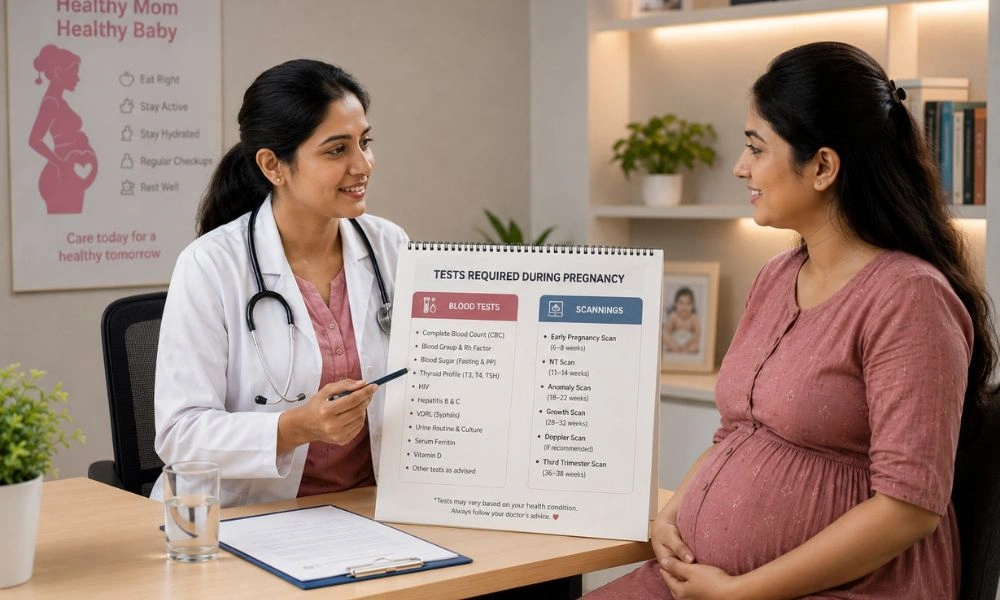
Tests and Scans in Pregnancy: What and When
| Test or scan | Usual timing | Why it is done |
|---|---|---|
| Blood group and Rh type | First visit | To plan for Rh-negative mothers and for any need for blood |
| Haemoglobin and blood count | First visit, repeated later | To find and treat anaemia, which is common |
| Urine tests | Every visit, culture when advised | To find infection and protein in the urine |
| Blood sugar tests | Early if at risk, otherwise 24 to 28 weeks | To find gestational diabetes |
| Thyroid test | Early, where advised | Thyroid problems are common and affect the pregnancy |
| Infection screening | First visit | Routine screening for infections such as HIV, hepatitis B and syphilis |
| Dating scan | 11 to 14 weeks | Due date, number of babies, early checks |
| Detailed scan | 18 to 21 weeks | To check the baby’s structure and the position of the placenta |
| Growth scan | Later, where advised | To check the baby’s growth and the amount of fluid |
Not every woman needs every test, and some need more. Your doctor will explain why each one is advised. Our page on pregnancy care and pregnancy tests and the article on the scans in pregnancy give more detail.
High-Risk Pregnancy Care
A pregnancy needs closer care when there is diabetes, high blood pressure, thyroid disease, twins, a previous miscarriage, preterm birth or caesarean, a low-lying placenta, poor growth of the baby, or when the mother is over 35. “High risk” does not mean something will go wrong. It means that more visits and extra scans are the sensible plan. Details are on our high-risk pregnancy care page, and our articles on high-risk pregnancy warning signs and high-risk care in Bengaluru explain the warning signs.
If you are expecting a high-risk pregnancy, the hospital choice matters even more. Look for a unit with a NICU on site and a doctor who has handled similar cases. Ask us which partner hospital would suit your situation.
Warning Signs: When to Call or Go to Hospital
- Vaginal bleeding
- Severe or constant abdominal pain
- Fluid leaking from the vagina
- Severe headache, blurred vision, or sudden swelling of the face and hands
- Fever, or burning when passing urine
- Your baby moving less than usual
- Regular painful tightening before 37 weeks
Do not wait for your next appointment. The NHS advice on reduced movements is clear: do not wait until the next day, call immediately, even in the middle of the night. Call the clinic, or go to the nearest hospital emergency department if it is out of hours or the problem is severe.
Planning the Birth and Life After
Towards the end of pregnancy we talk through labour, pain relief, the options for delivery, when to leave for hospital, and what to pack. Signs that labour may have begun include regular tightenings that become longer and stronger, a show of pink mucus, backache, and your waters breaking. Contact us or the hospital if contractions are regular and about five minutes apart, if your waters break, if there is bleeding, or if you are unsure about anything. Our delivery guidance page explains this in more detail.
After the birth, postnatal care covers recovery, feeding, family planning and mood. The World Health Organization recommends that mothers and healthy babies receive care in a health facility for at least 24 hours after birth, and at least three further check-ups in the first six weeks. Our article on postpartum recovery offers practical advice for the weeks after delivery.
Meet the Doctor
Dr. Kavitha Lakshmi Easwaran is a Senior Consultant Obstetrician and Gynaecologist. Her qualifications are MBBS and MD (OBG), and her Karnataka Medical Council registration number is 69643. You do not have to take our word for this: doctors registered in India are listed on the National Medical Commission’s Indian Medical Register, and you can search for a name there. We encourage you to do the same check for any doctor you are considering.
Dr. Kavitha’s approach is to explain each test and decision in plain words, so that you and your family know what is happening and why. Her work covers routine and high-risk pregnancy care. Women who want a second opinion are welcome, as well as those who plan to deliver under her care.
Visiting Us and Care Near You
The clinic is at 201-1, 1st A Cross, 2nd Main Road, East of NGEF Layout, Kasturi Nagar, Bengaluru 560043. Call 80887 01001 or 99019 25700 to book a time. Women come to us from many parts of Bangalore. If you want to read about travelling from your own area, choose from the pages below:
- Maternity care for patients from KR Puram, Horamavu and Banaswadi
- Maternity care near Indiranagar
- Maternity care near Kalyan Nagar
- Maternity care near RT Nagar
- Maternity care near Hebbal
- Maternity care near Whitefield
- Maternity care near Marathahalli
- Gynaecologist care in East Bangalore
Frequently Asked Questions
Which is the “best” maternity hospital in Bangalore?
No single hospital is right for everyone. The right choice depends on your health, your doctor, how far you live and what your insurance covers. Use the checks on this page, such as emergency readiness, NICU access, a clear written package and your doctor’s registration, to compare the hospitals you are considering.
Is Sai Speciality Center a maternity hospital?
No. It is a specialist clinic. Antenatal care is at the clinic, and delivery is planned with Dr. Kavitha at a partner hospital. We explain the arrangement at your first visit.
What should I look for in a maternity hospital?
Look for a doctor you trust, an operating theatre and anaesthetist available at all hours, a newborn intensive care unit, blood availability, support for normal birth, a clear written package, and a location you can reach quickly at night.
How can I check whether a doctor is registered?
Search the name on the National Medical Commission’s Indian Medical Register, and compare the qualification and state council number with what the doctor or hospital states. Dr. Kavitha’s Karnataka Medical Council registration number is 69643.
How can I check whether a hospital is NABH accredited?
NABH publishes a searchable list of accredited organisations on its website. Search for the hospital by name and check that the accreditation is current.
When should I book my first antenatal visit?
As soon as a home test is positive, and ideally before 12 weeks. An early visit lets us confirm the pregnancy, check your health and plan your scans and tests.
How many antenatal visits will I need?
It depends on your health and the pregnancy. The World Health Organization recommends at least eight contacts, and many women are seen more often as the due date approaches. High-risk pregnancies need more visits.
Can I change my doctor in the second or third trimester?
Yes. Bring all your scans, blood tests and notes so that nothing is repeated without reason. Scans and tests are advised only where they are needed.
Do you manage high-risk pregnancies?
Yes. Diabetes, high blood pressure, thyroid disease, twins, earlier complications and pregnancy after 35 need closer care, with more visits and extra scans. We also help you choose a suitable hospital for delivery.
Will Dr. Kavitha be present at my delivery?
Your delivery is planned with Dr. Kavitha at a partner hospital. Discuss the arrangements at your first visit, including what happens if labour starts when she is not available.
What should I ask about costs?
Ask what the package includes, the difference between normal and caesarean delivery, the charge per extra day, newborn care and NICU charges, and whether scans and tests are included. Get the answers in writing.
What should I bring to my first visit?
Scan, blood and urine reports, the names of any medicines and vitamins, the date of your last period if you know it, and records of earlier pregnancies or surgeries. Write down your questions too.
What should I do in an emergency?
Go to the nearest hospital emergency department and call us. Do not wait for an appointment if you have bleeding, severe pain, leaking fluid, a severe headache, fever or reduced baby movements.
Book a Maternity Consultation
To book your first antenatal visit, a second opinion or a pre-pregnancy check, call 80887 01001 or 99019 25700, or use the contact page. The clinic is at 201-1, 1st A Cross, 2nd Main Road, East of NGEF Layout, Kasturi Nagar, Bengaluru 560043 (open in Google Maps).
About this page: it is general information prepared by Sai Speciality Center, last updated in October 2026. It is not advice for any one patient and does not replace advice from your own doctor. If you think you are in an emergency, go to the nearest hospital emergency department.
Sources
- WHO: Recommendations on antenatal care for a positive pregnancy experience (2016)
- NHS: Your antenatal appointments
- NHS: Your baby’s movements
- NHS: Signs that labour has begun
- WHO: Quality care for women and newborns in the first weeks after childbirth (2022)
- National Medical Commission: Indian Medical Register
- NABH: Find a healthcare organisation